


The modern healthcare environment is constantly evolving, and the need for high-quality surgical instruments is ever-increasing. At AMG Medical, we know that each instrument is crucial in achieving surgical precision, patient safety, and procedural efficiency. One such instrument, the Allis tissue forceps, has proven to be a trustworthy tool for tissue grasp and stabilization in various surgical procedures.
Offering both power and precision, Allis tissue continues to be a staple in the surgical environment, aiding surgeons in performing successful procedures.
Clinical Evidence & Research Relevance
Research in surgical instrumentation highlights that toothed forceps designs, such as Allis Forceps, provide significantly improved grip stability compared to smooth-tip instruments. This makes them particularly useful in procedures requiring secure tissue fixation and retraction.
Clinical guidelines and surgical technique references also note that such instruments are essential in general surgery, gynecology, and orthopedic procedures where tissue control directly impacts surgical precision and healing outcomes.
What Are Allis Tissue Forceps?
Allis tissue forceps are surgical utensils that grip, hold, and secure soft tissues during surgical procedures. Allis forceps have distinctive serrated jaws and a locking mechanism that offer a secure grip, making them an ideal choice for tissue that needs to be pulled gently.
The features of the instrument enable surgeons to work with stability and efficiency.
Knowledge of the use of Allis’s surgical instrument is crucial in choosing the appropriate instrument for surgery.
Key Features of Allis Tissue Forcep
Interlocking Teeth for Secure Grip
The tip of the Allis Tissue Forcep consists of interlocking, sharp teeth. The teeth are designed to grip and secure the tissue to avoid slippage. This is essential in surgeries where accuracy is needed, as any movement is likely to affect the success of the operation. This enables the tissue to be securely held.
Ratchet Locking Mechanism
The ratchet locking mechanism allows the forceps to be locked into place once the appropriate tension is applied. This enables surgeons to relieve pressure and avoid fatigue. This also retains the grip, improving efficiency and control.
Surgical-Grade Stainless Steel Construction
AMG Medical Surgical’s Allis forceps are made from high-quality surgical-grade stainless steel. It is extremely durable, as it is corrosion- and wear-resistant. And it is easy to sterilise without damage to the instrument, making it suitable for use in critical environments.
Ergonomic and Balanced Design
The instrument’s handles provide a comfortable and secure grip to manipulate the Allis forceps. The balanced design of the instrument enables effortless manipulation, even in complex or delicate surgical situations, enhancing control.
Applications in Modern Surgical Practice
Allis tissue forceps are used in many surgeries for their effectiveness and effectiveness. They help surgeons to gain control, precision, and speed in surgery.
Understanding the Allis forceps uses may guide instrument selection for surgery.
Tissue Grasping and Stabilization
The tissue forceps surgical instruments are used to hold soft tissues such as fascia, muscle, and skin during surgery. This allows for more accurate and less distorted manipulation.
Surgical Retraction Support
Allis forceps are used to gently retract tissues to open the area for surgery. This provides increased visualization for safer and more efficient surgery.
Multi-Specialty Usage
These forceps are often used in:
- General surgery
- Gynecology
- Orthopedic procedures
- Minor and outpatient surgeries
They are suitable for both basic and complex surgeries.
Common Uses in Modern Surgery
Secure Tissue Handling
Allis tissue forceps are commonly used to hold dense tissues like fascia, skin, and muscle. Their firm hold allows tissues to be securely manipulated during surgery, ensuring precise control.
Tissue Retraction
In surgical procedures, the surgeon needs to see the area they are working on. Such tissue forceps are commonly used to retract tissues to provide greater visibility of the surgical site. This enhances efficiency and safety during surgery.
Applications Across Specialties
Forceps Allis Tissue find applications in various specialties, such as general surgery, gynecology, and orthopedics. Their adaptability makes them commonplace in surgeries, as they can assist in numerous procedures where strong tissue control is required.
Assisting Suturing and Closure
These forceps provide stability to the tissues being sutured, allowing for better control. This ensures the wound is closed correctly, aiding in recovery and preventing complications.
Benefits of Using Allis Tissue Forcep
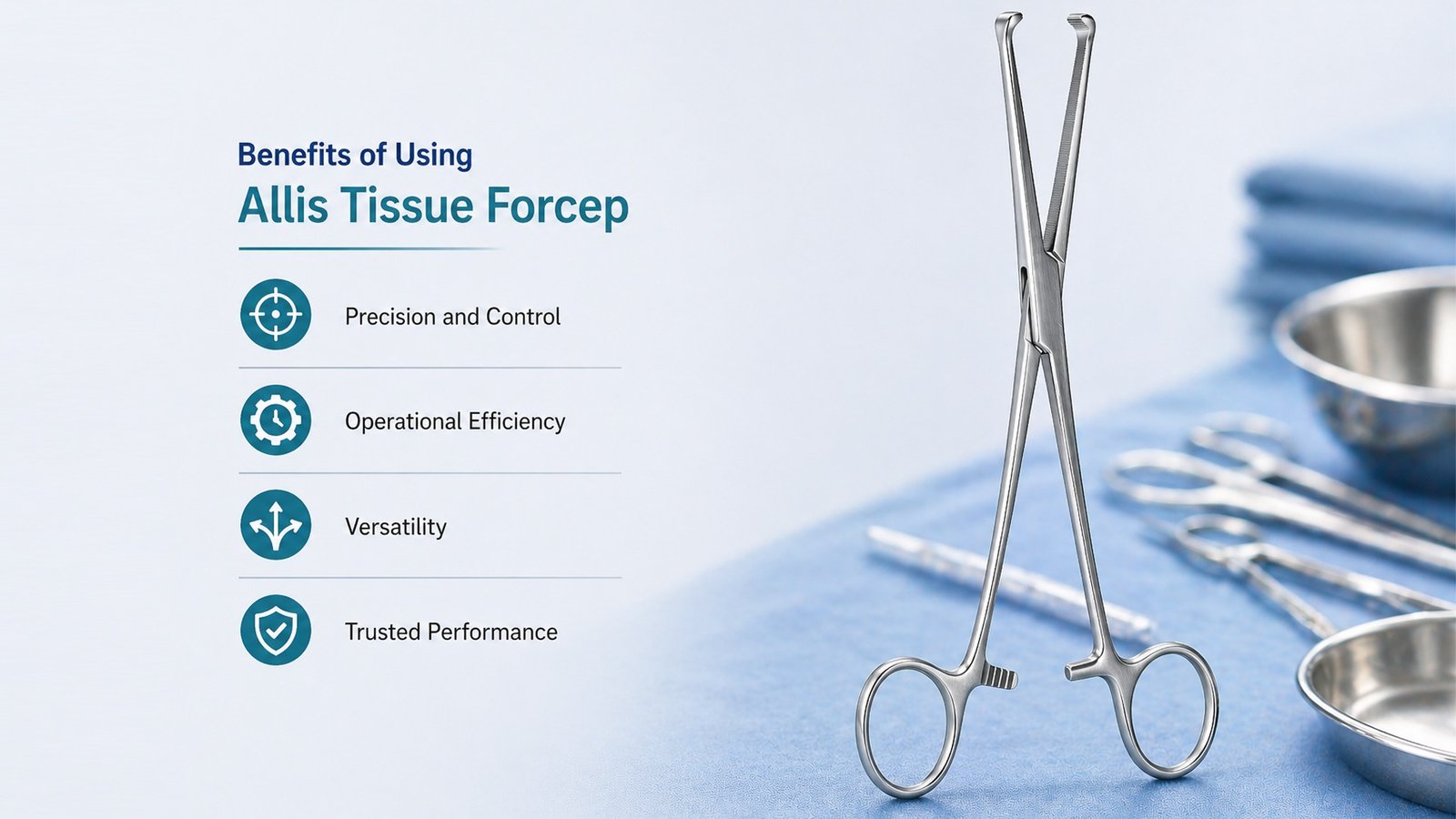
Precision and Control
Allis forceps provide a strong grip, which enables surgeons to work with precision. This precision is crucial for successful surgery.
Operational Efficiency
Locking mechanism eliminates the need for constant force, enabling surgeons to concentrate on the task at hand. This promotes efficient operating room procedures.
Versatility
The forceps can be used for a variety of surgical procedures and are therefore a useful addition to any surgical instrument tray. This makes them an essential tool for different surgical fields.
Trusted Performance
AMG’s medical focus on quality and compliance assures that these instruments perform reliably. This allows health practitioners to have confidence in them.
Conclusion
Allis Tissue Forceps continue to be a staple in surgical procedures due to their durability, accuracy, and efficiency. They offer a firm grasp and enhance surgical efficiency, making them a staple in operating theatres around the world. With AMG’s medical pledge to quality, these forceps are built to global standards and help health care professionals provide safe and efficient patient care.
Faqs
What are the differences between Babcock and Allis?
There are differences in the use of both forceps: Babcock forceps are used for delicate tissue, while Allis forceps are used for tougher tissue.
What are Allison’s forceps used for?
Allis forceps are surgical instruments with interlocking teeth used to firmly grasp, hold, or pull back dense, slippery, or heavy tissues (such as fascia, breast, or tumors) during general, gynecological, and orthopedic operations.
What else are Allis forceps called?
An Allis clamp (or Allis forceps) is a popular surgical tool. It was designed by an American surgeon, Oscar Allis, in 1883.
What is a feature of Allis forceps?
For one, Allis forceps have interlocking jaws and teeth. This is suitable for grasping and holding large or fibrous tissues.