

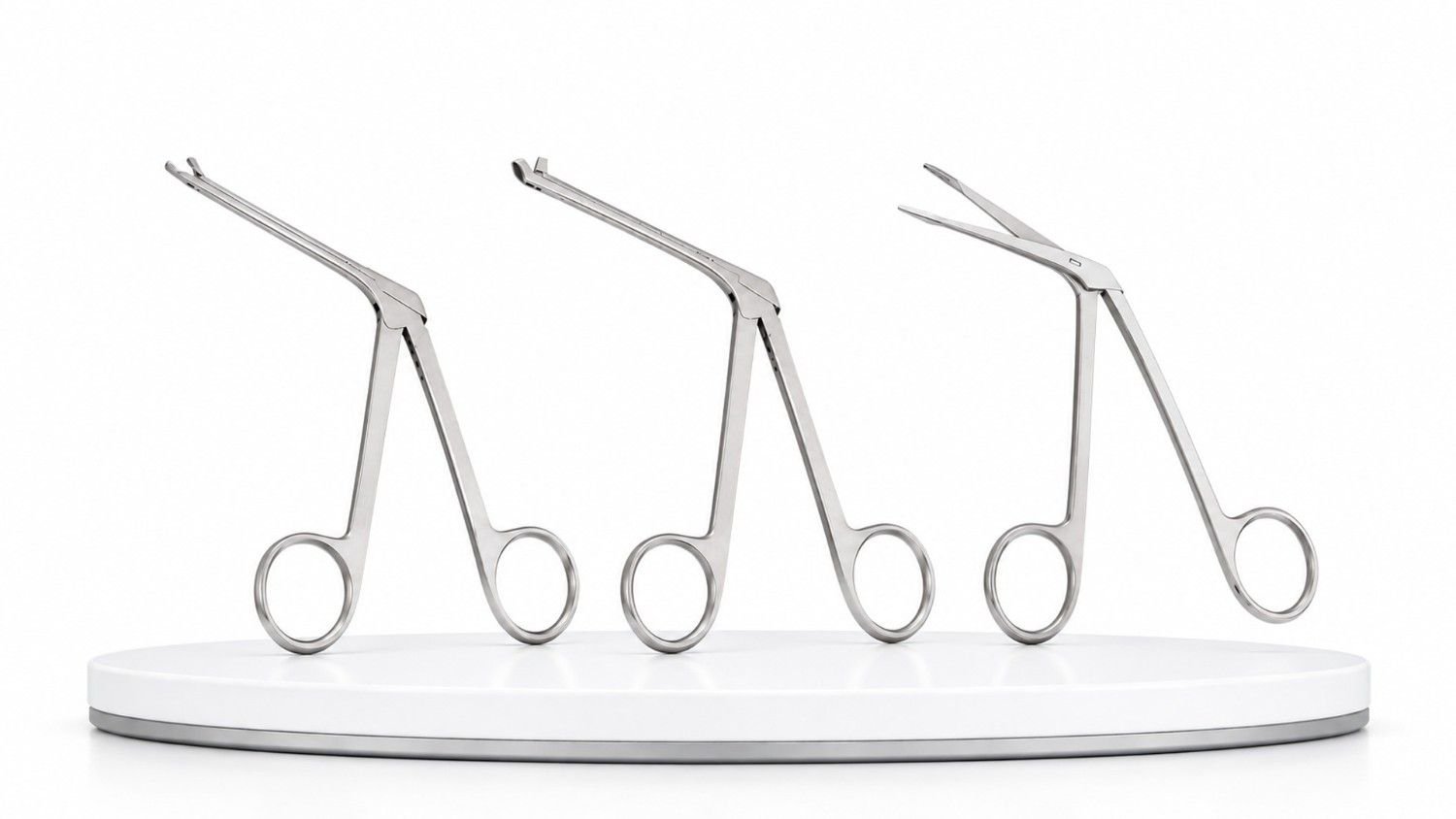
Nasal forceps are surgical instruments used to give ENT surgeons precise control over the very delicate, narrow structures of the nose. In the field of nasal surgery, the choice of instrument can be crucial due to the limited visibility and delicate tissue in this area, impacting surgical handling, precision, and overall procedural efficiency.
Today, endoscopy procedures are much more extensive than before and may include removal of nasal tissue, extraction of foreign bodies, sinus and septal surgeries, and other manipulations of the nasal and paranasal structures. The design of the forceps is crucial to the different procedures, and it is essential for surgeons, hospitals, surgical centers, and medical procurement teams to understand the options available to them.
The highest-quality ENT surgery instruments feature fine jaws, ergonomic handles, long-lasting materials, and accurate alignment. These properties enable surgeons to hold, control, dissect, or extract tissue during delicate surgery.
What Are Nasal Forceps?
Forceps Nasal are precision surgical instruments used by ENT surgeons for grasping, manipulating, removal, and holding tissue and other materials in the nose during surgical procedures. The small and specialized shapes enable the surgeon to reach areas that are hard to access with traditional surgical forceps.
Unlike general-purpose forceps, nasal models are often designed with elongated shafts and carefully shaped jaws to provide improved access and visibility within confined anatomical spaces. Depending on the procedure, they may have straight, curved, angled, serrated, or specialized tips.
When choosing the right forceps nasal design, some factors to consider are:
- Type of ENT procedure
- Anatomical location
- Tissue characteristics
- Required level of grip
- Surgeon preference
- The length and shape of the tip of the instrument.
- Procedure-specific requirements
The right tool can aid in achieving surgical control and facilitating efficient handling during ENT surgery.
Why Nasal Forceps Are Important in ENT Surgery
Nasal forceps are instruments used by surgeons to give them precise control when operating in the narrow, delicate anatomy of the nose. They have unique designs to facilitate access and handling and surgical efficiency for various ENT procedures.
Key benefits include:
- Accurate control of tissue: Enables careful manipulation and grasping of delicate nasal tissues.
- Better surgical access: Long and specialized design allows access to parts of the nasal cavity that are not otherwise accessible.
- Increased visibility: Some models, like bayonet forceps, provide better hand placement off the direct surgical field.
- Controlled extraction: When you want to carefully remove foreign bodies, tissue, or other materials.
- More efficient surgery: The proper forceps can facilitate routine as well as complex surgical procedures.
- Flexibility in use: There are different types of tips and configurations that can be used for a variety of ENT procedures.
- Minimized avoidable handling of tissue: The precision-designed jaws allow surgeons to work more carefully around neighboring tissues.
- Durability and reliability: A high-quality forceps can withstand repeated surgery and maintain reliability in clinical performance.
Common Types of Nasal Forceps
Forceps Nasal come in a variety of shapes and sizes, designed for different surgical procedures. Knowing the difference can guide healthcare providers to the right instrument for their clinical needs.
Straight Nasal Forceps
Straight nasal forceps have a linear shaft and jaw design and work best for procedures where access to the surgical site can be achieved directly through the nose. They are simple to construct and offer predictable handling characteristics and the ability for surgeons to grasp or manipulate accessible tissue and materials.
They are available in most ENT instrument sets due to their flexibility and simplicity of use.
Curved Nasal Forceps
Curved nasal forceps are the tools that are used to gain access to anatomical regions that may not be readily attainable with straight forceps. The curved profile enables the surgeon to access tissue at another angle with improved visualisation of the surgical field.
When used in procedures that involve areas of the nose that are harder to reach or deeper, their design can be especially effective.
Bayonet Forceps
One of the most common medical instruments in ENT surgery is bayonet forceps. They have an offset design where the surgeon’s hand is not in the same line of sight as the working tip reaches the surgical site.
This set-up can offer better visualization and minimize obstruction for delicate nasal procedures. Bayonet forceps are available with different tip shapes and lengths for various applications.
Nasal Dressing Forceps: Nasal dressing forceps are a tool for handling and inserting materials like nasal packing, gauze, or other dressing materials. Their design enables healthcare professionals to correctly place materials in the nasal cavity.
The long handle allows access to deeper areas, and the working tips allow the handling of dressing materials in a controlled way.
Alligator Nasal Forceps
The alligator forceps have a narrow, long shape and a mechanism to open and close the jaws by a handle. They are frequently employed for the pickup of small-sized objects or tissue in limited anatomical areas.
Their slender size can be helpful especially where the surgeon needs to be precise and has limited access.
Key Features of High-Quality Nasal Forceps
Not every surgical forceps provides the same accuracy, strength, or ease of use. Healthcare organizations should consider the design and manufacturing of the equipment when choosing ENT surgery equipment.
Precision-Machined Tips
Working tips must be aligned correctly and open and close easily. Controlled tissue handling and consistent instrument performance are achieved through precise manufacturing.
Medical-Grade Materials
Good stainless steel will offer durability, corrosion resistance, and the ability to withstand multiple sanitizations. For instruments that are used regularly in an operating room, the quality of the material is significant.
Ergonomic Handles
The ergonomic handle gives the surgeon added control and helps to keep the hands from getting tired during prolonged procedures. This can also help in ensuring smooth operations, which can lead to improved maneuverability of the instruments.
Proper Jaw Design
Each procedure calls for a different jaw shape. Serrated, smooth, toothed, or specialized jaws can offer different levels of grip, depending on the application.
Reliable Construction
A forceps that is well made should do the same whenever it gets used in the clinic and is sterilized.
How to Choose the Right Nasal Forceps
The right choice of nasal forceps begins with knowing the surgical use of the nasal forceps. Hospitals and procurement teams should not just pick an instrument based on the price, but also consider the performance, durability, and clinical suitability.
Take these into account:
- Requirements for procedure: Ensure the forceps are suitable for the desired ENT surgery.
- Length: Consider the desired surgical access and choose the correct length.
- Tip shape: Choose straight, curved, angled, serrated or smooth tips depending on clinical requirements.
- Material quality: Go for durable medical-grade materials.
- Ergonomics: Make sure the instrument is comfortable and easy to move around with.
- Sterilisation compatibility: Ensure the instrument is compatible with the sterilisation methods used in the facility.
- Reliability of the manufacturer: Select products manufactured by reliable manufacturers who have quality control processes in place.
By carefully choosing the parts, healthcare facilities can create an ENT instrument set that will serve their patients well both in the present and in the future. Oto-acoustic equipment selection can also be used to develop comprehensive surgical inventories by comparison for the procurement team, which should be procedure-specific.
The Role of Nasal Forceps in Different ENT Procedures
Depending on the design and configuration, nasal forceps can be used in a variety of applications in ENT. These are often used in many sets of surgical instruments because of their accuracy and easy availability.
They can aid with processes related to:
Nasal Foreign Body Removal
With the aid of a specialized pair of forceps, the clinician can grasp and gently remove foreign bodies from the nasal cavity, with control over the movements of instruments.
Nasal Packing and Dressing
The dressing forceps are used for precise placement of packing and other items during postoperative care and for specific ENT procedures.
Sinus and Nasal Procedures
Long and angled forceps can reach areas that may not be accessible with regular forceps to aid in controlled manipulation of tissue during appropriate procedures.
General ENT Procedures
Nasal forceps are a useful addition to surgical instrument sets, offering a versatile range of options to address various routine ENT procedures.
The correct forceps nasal configuration can assist the surgeon in the proper access and control for specific procedures while providing a clear and efficient operative field.
Maintaining Nasal Forceps for Long-Term Performance
Good instrument care is crucial to the accuracy and dependability of the forceps nasal. Proper and regular cleaning, inspection, sterilization, and storage can prolong the lifespan of surgical instruments.
Healthcare facilities should:
- Follow manufacturers’ guidelines to clean instruments.
- Check for misalignments and damage to tips and jaws.
- Inspect smooth operation of check handles and joints.
- Use approved sterilization methods.
- Use a suitable surgical tray to store instruments.
- Until instruments are evaluated, do not use those that are damaged.
Regularly maintained surgical equipment helps to safeguard the investment and ensures consistent and safe use in the clinic. Care of instruments for the ear, nose,e and throat (ENT) is particularly important as they can be used often in various procedures and clinical settings.
Why Quality Matters When Selecting ENT Surgery Instruments
In ENT hospitals and surgical centers, the caliber of surgical instruments may make a difference in workflow, surgeon self-confidence, and procurement cost for the long haul. Machining and manufacturing issues can cause instruments to wear out sooner than expected, experience misalignment or off-specification performance, and therefore cost more for replacement.
A high-quality instrument, on the other hand, is created to perform in a consistent manner on repeated use in the clinic. Through precision manufacturing, quality control, and reliable materials, surgical teams can be sure they have the necessary tools when they need them.
Healthcare procurement teams should therefore consider suppliers in the following ways:
- Product quality
- Manufacturing capabilities
- Regulatory compliance
- Product consistency
- Technical support
- After-sales service
With the help of a reliable supplier, healthcare organizations can create a more stable surgical instrument supply chain and guarantee that the instruments utilized in ENT surgery are both useful and appropriate for today’s clinical settings.
How AMG Medical Supports ENT Healthcare Professionals
At AMG Medical, we understand that ENT professionals require precision, reliability, and consistent quality when selecting surgical instruments. We produce products with high precision and quality, ensuring that hospitals, surgical centres, distributors, and procurement teams can rely on our solutions for challenging clinical settings.
Nasal forceps, along with specialized instruments, can be used to get the optimal setup for the ENT department. Consistency in manufacturing, material quality, ergonomic design, and product availability are crucial factors to consider in surgical instrument portfolios.
AMG Medical is committed to helping healthcare organizations with medical and surgical instrument solutions tailored to the practical needs of healthcare professionals and procurement staff.
Conclusion
In the field of ENT surgery, nasal forceps are crucial tools that enable the surgeon to have precise and controlled handling of tools during nasal cavity procedures. Various styles of forceps, such as straight, curved, or bayonet, are available and can be adapted for different uses and configurations for dressing and clinical applications.
The selection of the appropriate instrument should be based on the following considerations: procedure needs, tip configuration, material quality, ergonomics, durability, and compatibility with sterilization. Healthcare entities can reap benefits from investing in top-notch ENT surgery equipment, including enhanced surgical efficiency, improved instrument reliability, and long-term value.
With the increasing evolution of ENT procedures, precision-engineered instruments will continue to play a pivotal role in ensuring safe and effective surgical care. To enhance their surgical skills, hospitals and procurement teams can partner with trusted manufacturers and opt for instruments that align with the day-to-day demands of contemporary ENT practitioners.
Frequently Asked Questions
What is the difference between straight and curved nasal forceps?
Straight forceps can be used to access more readily accessible areas, and curved forceps can be used to access deeper or less accessible parts of the nose.
Why are bayonet forceps used in ENT surgeries?
They are offset-designed to provide a better field of view and allow the surgeon’s hand to stay out of the way during delicate nasal procedures.
Which instruments are considered most important in ENT surgery?
The instruments used for ENT surgery vary depending on the procedure; typical instruments include forceps, scissors, retractors, suction instruments, speculums, and specialized nasal instruments.
Why is it that a special ENT instrument has become so important?
Specialized instruments allow surgeons to have precise equipment to work on delicate procedures with access and control. They are thus a part of the current surgical treatment in ENT.