

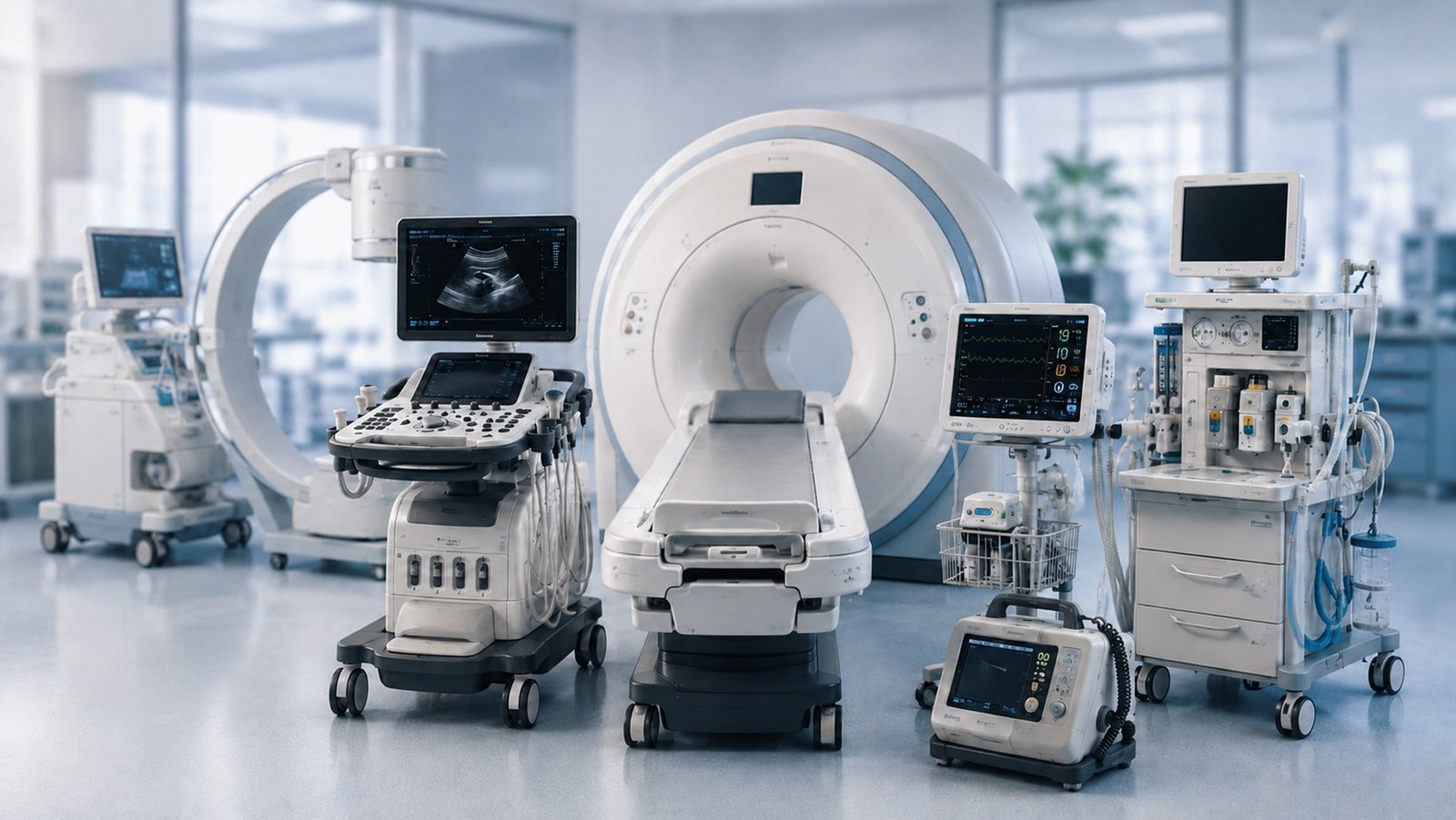
Hospitals and clinics are constantly challenged to enhance the clinical services they provide while simultaneously managing equipment spend, maintenance, and future operating needs. Refurbished medical equipment companies can offer an alternative for hospitals, diagnostic centres, surgical centres, and healthcare distributors when acquiring brand-new systems is not always feasible.
The market for refurbished medical equipment solutions has changed significantly. Refurbishment does not necessarily mean used equipment; it also requires very detailed inspection, component replacement, software corrections, performance testing, safety testing, and quality control. Key players in the healthcare technology sector include major players and specialty providers in the expanding market.
However, when purchasing refurbished medical equipment, some factors are more important for procurement professionals than just the price. All the following should be considered before purchasing equipment: Condition of equipment, standards of refurbishment, equipment documentation, warranty, technical support, availability of spare parts, and suitability for regulatory purposes.
Best 5 Refurbished Medical Equipment Companies
AMG Medical
AMG Medical provides healthcare organizations, hospitals, surgical centers,s and medical distributors with dependable medical and surgical equipment solutions. The strategy emphasizes helping buyers in the healthcare industry make a well-informed decision on the product’s quality, availability, procurement, and cost.
AMG Medical could be a procurement partner that recognises the need to assess equipment through clinical needs, product condition, supplier reliability, and operational requirements when considering refurbished options.
Here are some reasons why Healthcare Buyers might want to consider AMG Medical:
Work in the healthcare and surgical equipment sector. Concentrate on health care and surgical products.
- Support input for hospital/healthcare procurement needs.
- Emphasis on product quality and reliability
- Solutions for healthcare organizations and distributors
- Concentrate on guaranteed supply and procurement value over the long run
One of the primary concerns for hospitals and distributors is the ability to consistently provide equipment and suppliers to support clinical operations and meet procurement and quality standards.
AMG Medical will therefore form part of a wider consideration of medical equipment suppliers, especially for medical and surgical equipment sourcing by healthcare organisations seeking a reliable supplier of medical equipment.
GE HealthCare
GE HealthCare is a leading player in the refurbished medical equipment industry. Refurbishment services range from imaging and monitoring technologies, and numerous programs are available that help healthcare organizations gain access to proven GE systems at a lower cost than new systems.
GE HealthCare is one of the top companies in the refurbished medical equipment sector, according to industry sources, and is represented by its A1-Sure and GoldSeal programs.
Healthcare Buyers take an active interest in GE HealthCare because…
For facilities in need of refurbished diagnostic and imaging technologies but still want to retain the benefit of existing manufacturer platforms, GE HealthCare can be a relevant solution.
For healthcare procurement teams, there are a few factors to consider:
The model and configuration of the equipment.The model and the condition of the equipment.
- Refurbishment standards
- Available warranty
- Technical support
- Software compatibility
- Replacement parts
- Expected service life
The compatibility and familiarity with the existing infrastructure can also have an impact on procurement decisions for hospitals already using GE systems.
Siemens Healthineers
Yet another leader in healthcare technology, Siemens Healthineers has a dedicated refurbished equipment line. It has an Ecoline program which offers refurbished imaging and therapy systems that have been refurbished according to a defined process before being offered to healthcare organizations.
Ecoline systems are refurbished to the company’s standards and are marketed as an alternative to new imaging and therapy systems that offer lower costs, the company says.
Siemens Healthineers’ Success Goes Beyond the Sum of its Parts.
When looking at refurbished Siemens systems, some key areas to consider are:
- System condition
- Refurbishment documentation
- Available configurations
- The equipment will be provided with service and maintenance support.
- Warranty terms
The design needs to be compatible with current infrastructure. The design must be adaptable to the existing infrastructure.
In addition to refurbishment, Siemens provides pre-owned and reconditioned systems to provide different options for healthcare organizations depending on their clinical needs and budget.
Philips
Philips offers a dedicated circular equipment strategy, with its Circular Edition and Select Edition. It has refreshed its products and systems like MRI, ultrasound, CT, mobile C-arm, and image-guided therapy systems.
Philips says its Circular Edition systems go through a systematic OEM refurbishment procedure that includes cleaning, disinfection, performance and safety inspections, cosmetic refurbishment, and replacement of components as needed.
Why Philips is ranked as a leader in health technology spending by Healthcare Buyers.
Philips can be an option for facilities that are seeking refurbished imaging and therapy systems and need to stay connected to a large manufacturer’s service network.
When assessing the project, procurement teams should consider:
- System configuration
- Refurbishment level
- Warranty
- Software and upgrade options will be provided.
- Installation requirements
- Service availability
- Total cost of ownership
Philips also sees its remanufactured offerings as complementing a circular healthcare approach that will extend the life of healthcare equipment and lower its material usage.
Canon Medical Systems
Another well-known healthcare technology firm with a refurbished diagnostic imaging product offering is Canon Medical Systems. Its Secondlife activities are geared around the idea of achieving an extended life cycle for selected equipment by refurbishing and evaluating its technical viability.
Canon Medical is one of the big players in the refurbished medical equipment market, according to industry reports.
Why Canon Medical is Relevant
Potential Canon buyers for healthcare systems should look into the specific model, refurbishment history, technical condition, upgrades available, warranty, and long-term service support.
Organizations considering capital expenditures but wanting to continue to leverage existing diagnostic technologies may find that Canon’s involvement in refurbished imaging makes it a viable choice.
For procurement teams, the key question should remain whether the refurbished system meets the facility’s clinical requirements and expected operating conditions.
What Should Hospitals Consider Before Buying Refurbished Equipment?
There is a need for a structured evaluation process when it comes to choosing among refurbished medical equipment suppliers.
Refurbishment Process
Inquire from the supplier about what treatment the equipment has been subjected to. The process for the refurbishment of any equipment should be documented and suitable for the equipment type.
Equipment History
If available, inspect the age, use, maintenance, and reason for equipment retirement.
Performance Testing
Verify functionality of critical functions and that appropriate calibration and/or safety checks have been performed.
Replacement Parts
Decide if any critical parts were replaced and if replacement parts will be available for the future.
Warranty and Support
While a warranty can offer extra cover, procurement teams need to pay attention to the length of the coverage, coverage limitations, parts coverage, and service coverage.
Regulatory Requirements
Healthcare facilities should ensure that the equipment conforms to the relevant regulatory and safety standards for the use and market for which it is intended.
Operating Costs
Other factors should also be taken into account when deciding the purchase price. This should also include maintenance, installation, upgrades, repairs, consumables, downtime, and eventual replacement.
Refurbished Surgical Equipment: What Buyers Should Know
Refurbishment is not restricted to big diagnostic systems. Depending on the supplier and product type, other surgical equipment that has been refurbished may be available to healthcare organizations.
Surgical equipment procurement teams should consider the following factors:
- Mechanical functionality
- Instrument condition
- Electrical safety – if applicable.
- Clinically compatible with workflows.
- Sterilisation for reusable products
- Replacement parts and components are available. Replacement components and parts are available.
- Manufacturer/ supplier support
Products that are essential for surgical procedures may have an impact on operating-room workflow; the facilities must adopt a more comprehensive evaluation process for these products.
The Role of Equipment Refurbishment Services
The refurbishment services provided by professionals can go beyond just being equipment preparation for resale. Services can involve inspection, repair, installation, maintenance, software upgrades, technical support,t and trade-in/lifecycle management, depending on the provider.
After the purchase of equipment, these services can be especially beneficial to hospitals that require ongoing assistance.
As they are assessing a supplier, ask:
- Is installation included?
- Do you have technical support available?
- Are there any spare parts available?
- Do software updates work?
- Is preventive maintenance available?
- What do you do if the equipment fails?
- What will be the service support life?
The value of a supplier that can offer complete equipment refurbishment services can be more helpful in the long term than a refurbished products salesman.
Refurbished Equipment and Healthcare Sustainability
Another driving factor is sustainability for healthcare organizations to consider refurbishment. Medical equipment can be used longer, which means less new material will be required and even functional equipment will not be disposed of sooner.
For Philips, an example of the circular equipment strategy is to maximize product life cycles, minimize waste, and materials input. This overall strategyfor thee circular economy is also embodied in its Circular Edition systems.
Refurbished equipment can therefore be a part of a hospital’s sustainability strategy, along with the financial and operational goals.
But sustainability is not to be used in place of clinical and safety requirements. Equipment should be appropriate for the application and be adequately tested before service.
Final Thoughts
The refurbished medical equipment market has become an important part of modern healthcare procurement. Major healthcare technology companies such as GE HealthCare, Siemens Healthineers, Philips, Canon Medical Systems, and FUJIFILM Healthcare have established refurbishment or lifecycle programs that provide healthcare organizations with alternatives to purchasing new equipment.
However, the “best” company depends on the healthcare facility’s specific needs. Equipment category, technical requirements, refurbishment standards, regulatory considerations, warranty, service support, and total cost of ownership should all influence the final decision.
For hospitals and healthcare procurement teams, the goal should not simply be to find the cheapest refurbished product. The better objective is to find reliable equipment from a trustworthy provider that can support clinical performance, operational continuity, and long-term value.
Faqs
What are the best refurbished medical equipment companies in 2026?
Notable companies active in the market include AMG Medical, GE HealthCare, Siemens Healthineers, Philips, and Canon Medical Systems. The right choice depends on the equipment type, clinical requirements, region, and available service support.
Is refurbished medical equipment reliable?
It can be reliable when it has undergone a documented refurbishment process, appropriate performance testing, safety checks, and quality inspection. Buyers should always verify the specific refurbishment standards and warranty offered.
What should hospitals ask refurbished equipment suppliers?
Hospitals should ask about equipment history, refurbishment procedures, testing, replacement parts, documentation, warranty, regulatory compliance, maintenance, and technical support.
Is refurbished surgical equipment a good option for hospitals?
It can be appropriate for certain applications when the equipment is properly inspected, tested, maintained, and suitable for the intended clinical use. Hospitals should evaluate each product individually rather than assuming all refurbished equipment has the same quality level.
Why are refurbishment services important?
Professional equipment refurbishment services can provide inspection, repair, testing, maintenance, installation, and technical support, helping healthcare organizations manage equipment throughout its useful lifecycle.
One Response