

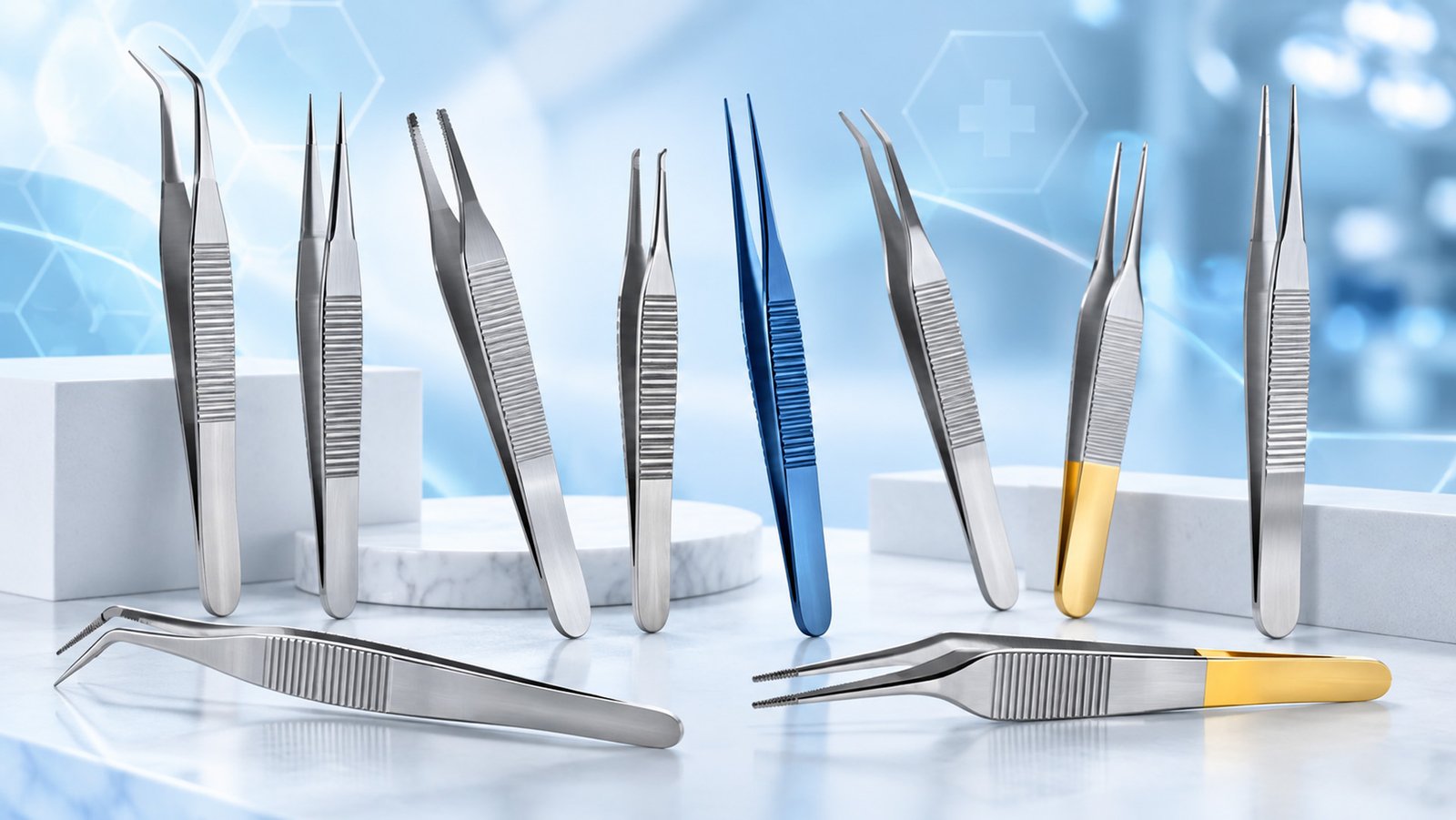
A small instrument could make a big difference when it comes to handling, control, and precision in surgery. Thumb forceps are one of the necessary tools used by surgeons, nurses, and other healthcare workers to hold, grasp, position, and move tissue or materials during an operation.
A simple tweezer-like design enables controlled handling without locking. But not all forceps are created equal. Some tips, teeth, serration, length, and construction differences make some designs more suitable for certain surgical applications.
Throughout the purchase of surgical instruments in Pakistan, it is crucial for hospitals and healthcare procurement teams to understand these distinctions, ensuring that the instruments they choose align with the operational needs of their surgical procedures while also providing durability and reliability.
What Are Thumb Forceps?
Thumb forceps are hand-held forceps that are not locking and are used by applying pressure with the thumb and fingers. These are typically made with two linked arms that spread when released and snap shut when pressure is applied.
These instruments are used for handling tissues, dressings, sutures, etc., in medical or surgical procedures according to the type of tip.
They are lightweight and have direct finger control m, making them especially helpful when a controlled manipulation of the object is desired rather than a locking grip obtained from a hemostatic or other ring-handled forceps.
Why Precision Matters in Surgical Forceps
When choosing surgical instruments, accuracy is a key factor. An instrument should give the correct amount of control for the job to be done without causing unnecessary damage to the material or tissue being manipulated.
Therefore, the design of the end of the forceps is an important factor.
Depending on the specific application, fine, smooth tips can be used for delicate handling, and toothed or serrated tips can offer more grip when it is necessary to have extra secure tissue handling.
For healthcare facilities, it is not enough to select the instrument based on the general name of the instrument; instead, the selection should depend on the type of procedure and its intended use.
Common Types of Thumb Forceps
There are different types of major forceps, and it is beneficial for health care providers and procurement departments to be familiar with them to choose the appropriate instrument for their needs.
Adson Thumb Forceps
The profile of the Adson forceps is quite short and wide. They are compact, allowing for controlled handling by the clinician, and are often associated with surgery where precise tissue handling is required.
Depending on their use, the tips of different Adson configurations may be smooth, serrated o, or toothed.
Brown-Adson Thumb Forceps
Brown Adson thumb forceps have a row of fine, close-set teeth at the active end. This setup is made to make sure that the teeth are protected and spread out between the tissue.
Their design allows for their use in applications where controlled grasping is needed.
When buying a Brown Adson forceps configuration, procurement teams need to confirm the actual tip pattern, size, materials used, and application of the product, not just from the product name.
Dressing Thumb Forceps
The objective of dressing forceps is to pick up dressings, gauze, sutures, etc. for dressing. They are frequently used in applications where tissue manipulation isn’t a key component.
Dressing forceps with a thumb may be beneficial for dressing changes and other situations where controlled handling of sterile materials is necessary.
Toothed Thumb Forceps
One or more teeth are added to the tip of the design to increase grip, known as a toothed design. They can be chosen for procedures that call for secure tissue handling.
The teeth can be arranged in various combinations and numbers, depending on the application, so the design should be chosen by the clinician.
Serrated Thumb Forceps
Serrated tips have small grooves which can allow for controlled contact with the material being held. They can be used when a firm but controlled grip is needed, but the toothed forceps have not been engaged.
Thumb and Tissue Forceps: Understanding the Difference
The names sometimes overlap for surgical forceps. Thumb and tissue forceps are usually mentioned together because many thumb forceps are specially designed for use in handling tissue.
But forceps for tissues need not be the same.
Some are designed to be used on soft tissue, others for firm tissue. The geometry of the tips, the shape of the teeth, the width and the length of the instrument may all affect the performance of the forceps.
So when deciding on which configuration to use, healthcare professionals should take into account the intended use.
How Thumb Tissue Forceps Support Surgical Procedures
Thumb tissue forceps give direct manual control of the forceps, giving the clinician the freedom to grasp and move tissue or other materials without the use of locking forceps.
They can be applied to a variety of surgical settings such as:
- General surgical procedures
- Minor surgical procedures
- Wound management
- Tissue handling
- Dressing applications
- Suturing-related tasks
- Selected specialty procedures
The forceps used should always be selected by the procedure, the nature of the tissues,nd the clinical technique.
Key Features to Consider When Selecting Thumb Forceps
There are a number of specifications which procurement teams will need to consider when buying forceps for a hospital or surgical center.
Tip Design
One of the most crucial features is the tip. There are three types: smooth, serrated, and toothed; they are all different in terms of grip and should be chosen depending on the application.
Instrument Length
There are various lengths of forceps. Shortest instruments may be used for good control, and longer ones are useful when the working area is deeper, or access is more restricted.
Material
Stainless steel that meets the requirements of the clinical application and processing is commonly used to make high-quality surgical instruments.
The quality of materials may affect the life of the instrument, corrosion resistance, surface finish, and durability.
Jaw Alignment
When closed, the two working ends should touch just right. Misalignment may make handling more difficult and can be a sign of a manufacturing problem or may be caused by damage to the instrument.
Surface Finish
A uniform surface finish ensures easier inspection and cleaning procedures are undertaken, as well as enhancing the quality of the instrument.
Ergonomics
Thumb forceps should feel like a familiar instrument and be comfortable in the hand. When used repeatedly, consistency of spring action and proper tension can aid clinicians in remaining in control.
What Procurement Teams Should Check Before Buying
Choosing surgical instruments isn’t just about trying to compare prices. Product specifications and manufacturing consistency, supplier reliability, and long-term value should be evaluated in the hospital.
Prior to buying, procurement teams should review:
- Exact instrument type
- Tip configuration
- Overall length
- Material specification
- Surface finish
- Intended clinical application
- The instructions for reprocessing and sterilization are provided.
- Packaging requirements
- Supplier documentation
- Availability and lead time
A clear specification can also assist hospitals in putting in place a unified inventory of instruments and decrease ambiguity when ordering again.
Quality and Durability in Surgical Instrument Procurement
Surgical instruments in Pakistan are often repeatedly handled, cleaned, inspected, sterilized,nd stored. Thus, they need to be designed in an appropriate fashion for the desired workflow.
Evaluation of quality should not be based solely on what the eye sees. When buying, procurement teams should think about.
- Production accuracy: Uniform dimensions and tip alignment for reliable handling.
- Mechanical function: The instrument should open and close without any snags and at the right tension.
- Corrosion resistance: Materials and finishes should be suitable for the reprocessing facility.
- Repeat orders: Instruments must comply with the same approved specifications.
- Maintenance: Facilities should have the necessary inspection, cleaning, sterilisation and storage protocols in place.
Avoiding the Wrong Forceps for the Application
One of the most common procurement mistakes is treating all forceps as interchangeable.
The forceps used for dressing materials may not be appropriate for use in tissue handling. Likewise, an instrument with small teeth might not be suitable for all tissues and indications.
This is why it’s helpful to know the different types of thumb forceps when creating or standardizing a surgical instrument inventory.
Procurement teams should ask: “What will we need to do to ensure that we get the forceps we need?”
Which forceps to use for this given procedure and application?
This change can result in more informed purchasing decisions and improved instrument standardization.
AMG Medical: Supporting Surgical Instrument Procurement
Precision, quality, and the practical needs of healthcare facilities are all taken into account when choosing surgical instruments at AMG Medical.
In the case of hospitals, surgical centers, or healthcare distributors, the ideal instrument is one that is able to match the procedure it is designed for and also aligns with suitable expectations for construction, handling, uniformity, and supply reliability.
From the procurement team to the product, to the surgeon and their staff, assessing the specifications of tissue-handling instruments, dressing instruments, surgical tools, and other products can help to build a more reliable surgical stock.
Conclusion
Although the design of thumb forceps may seem simple, precision, construction, and the right choice of thumb forceps for surgical and clinical uses are important. Healthcare providers can select instruments to fit the needs of the tissue and dressing processes, as well as surgical procedures, with various tip configurations and designs.
To help hospitals and procurement staff with inventory management and purchasing, it is important to understand the difference between standard, Adson, Brown-Adson, dressing, toothed, and serrated configurations.
A surgical instrument is the right tool for the job, not just its name. The design, specifications, quality, intended application, and reliability all have a role to play in the effectiveness of the surgical instrument procurement strategy.
Faqs
What are thumb forceps used for?
To grasp, position, and move tissue, dressings, sutures, or other materials during appropriate medical and surgical procedures with controlled grasping.
How many types of thumb forceps are there?
Typical ones include smooth, serrated, toothed, Adson, Brown-Adson, and dressing forceps. The type to be used depends on the clinical application.
What do Brown-Adson thumb forceps do?
The multiple fine teeth in Brown-Adson designs offer a controlled grip. They can be chosen for applications that need secure tissue handling.
Are thumb forceps reusable?
A large number of surgical thumb forceps are reusable; it depends on the product. Healthcare facilities should adhere to the manufacturer’s instructions to clean, disinfect, inspect, and maintain equipment.
What should hospitals do when it comes to surgical thumb forceps?
When procuring tips for procedures, hospitals should take into account the intended procedure, tip configuration, length, material, ergonomics, quality, reprocessing needs, the supplier’s documentation, and the timeframe in which supplies will be available.