

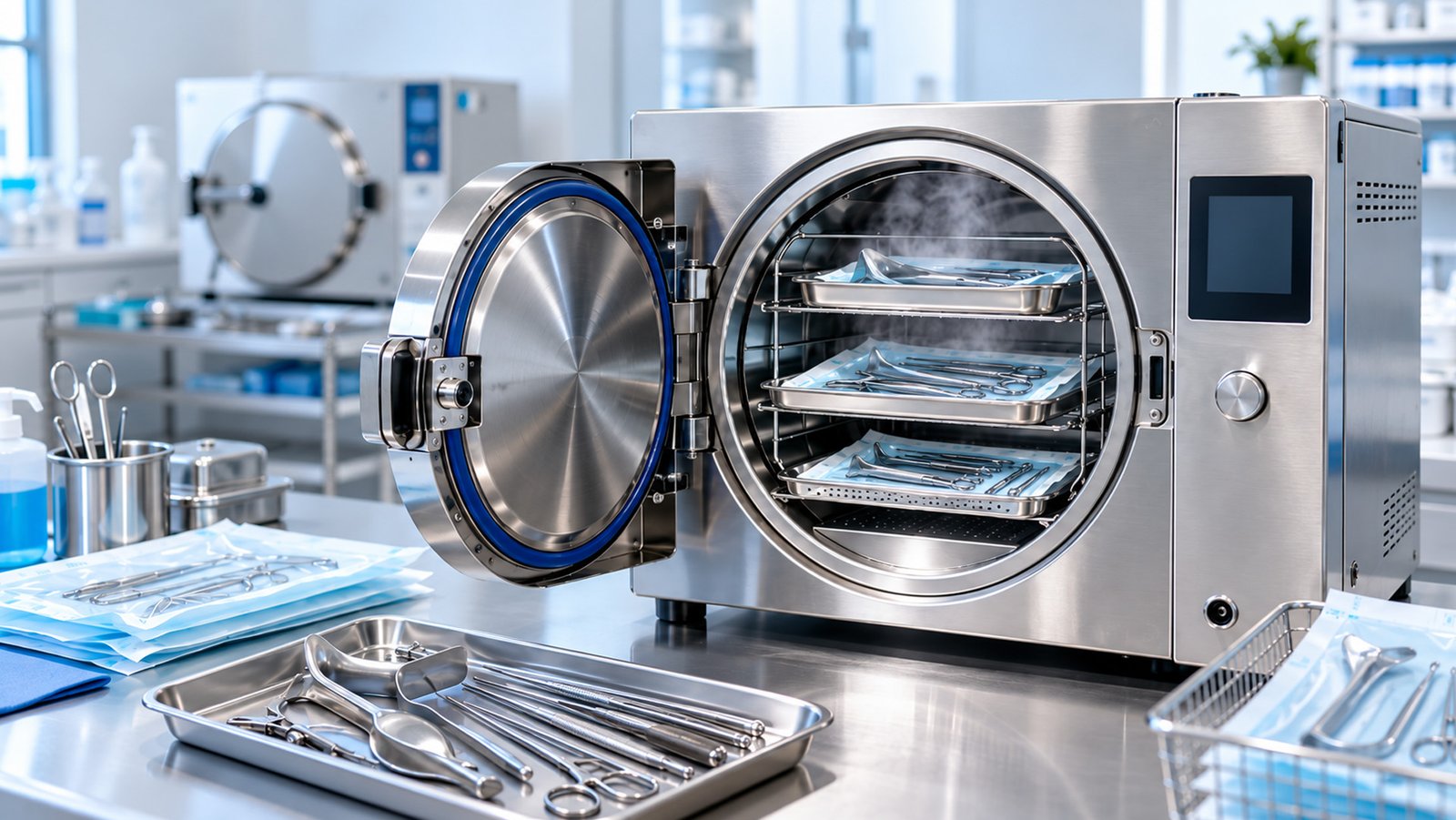
Sterilization is an essential part of infection prevention in hospitals, dental clinics, laboratories, and other healthcare facilities. Medical instruments must be properly processed before they are reused to help protect patients and healthcare professionals from harmful microorganisms. An autoclave machine plays an important role in this process by using pressurized steam to sterilize compatible instruments and materials.
However, not every healthcare facility needs the same type of sterilization equipment. Small clinics may require compact machines, while hospitals with busy surgical departments often need larger systems capable of processing multiple instrument sets.
In this guide, we explain the different types of autoclaves, their uses, the factors to consider before purchasing one, and how healthcare facilities can select equipment that meets their operational requirements.
What Is an Autoclave Machine?
An autoclave is a specialized device that sterilizes compatible surgical instruments, equipment, and materials using saturated steam under pressure at a controlled temperature and for a specified exposure time.
To understand the autoclave definition, it is important to distinguish sterilization from ordinary cleaning and disinfection. Cleaning removes visible dirt and organic material, while disinfection reduces many harmful microorganisms. Sterilization aims to eliminate all viable microorganisms, including bacterial spores, when a validated process is completed successfully.
In healthcare settings, autoclaves are commonly used to process reusable surgical instruments, dental instruments, and other heat- and moisture-resistant items.
The correct sterilization method depends on the instrument manufacturer’s instructions, the type of material, and the intended clinical application. Not every medical device is suitable for steam sterilization.
How Does an Autoclave Work?
An autoclave uses pressurized steam to transfer heat to the items inside its chamber. The process generally involves several stages.
1. Instrument Preparation
Before sterilization, reusable instruments must be cleaned to remove blood, tissue, and other residues. They should then be inspected, assembled, and packaged according to the manufacturer’s instructions and facility procedures.
2. Air Removal
Air inside the chamber can prevent steam from reaching all surfaces. Depending on the machine, air is removed through gravity displacement or a mechanical vacuum system.
3. Steam Sterilization
The machine introduces steam and maintains the required temperature and exposure time. Common steam sterilization temperatures include 121°C and 134°C, but the correct cycle depends on the equipment, load, packaging, and validated instructions.
The combination of heat, moisture, and exposure time damages microorganisms and supports effective sterilization.
4. Drying and Cooling
After the exposure phase, the machine removes steam and may perform a drying cycle. Items must be handled safely and allowed to cool before they are released for use.
5. Cycle Monitoring
Healthcare staff should review cycle records and use appropriate chemical and biological indicators according to established protocols. A completed cycle does not automatically guarantee that every item is sterile.
Types of Autoclave Machines Used in Healthcare
Different facilities have different sterilization requirements. Understanding the main types of autoclaves can help healthcare buyers select equipment that matches their workload, available space, and instrument-processing needs.
1. Gravity Displacement Autoclave
A gravity displacement autoclave uses incoming steam to push air out of the chamber. It is commonly used for suitable unwrapped instruments, laboratory materials, and compatible solid items.
Best suited for: Applications where the load allows effective steam penetration through gravity displacement.
Key consideration: This type may be unsuitable for certain wrapped loads, porous materials, or instruments with complex internal channels unless the machine and cycle are specifically validated for those items.
2. Pre-Vacuum Autoclave
A pre-vacuum autoclave uses a vacuum system to remove air from the chamber before steam enters. This supports better steam penetration into wrapped instrument sets and more complex loads.
These machines are commonly used in hospitals and central sterile services departments that process a variety of reusable surgical instruments.
Best suited for: Healthcare facilities processing wrapped instruments and compatible loads that require effective air removal.
Key consideration: Buyers should evaluate vacuum performance, cycle options, maintenance requirements, and the types of instruments the equipment is validated to process.
3. Tabletop Autoclave
Tabletop autoclaves are compact machines designed for smaller healthcare environments. They are commonly considered by dental practices, outpatient clinics, and medical offices with limited space.
Depending on the model, these machines may offer different chamber capacities and sterilization programs.
Best suited for: Smaller facilities with lower instrument-processing volumes.
Key consideration: Confirm the chamber size, cycle options, drying performance, and compatibility with the instruments used in the practice.
4. Large-Capacity Hospital Autoclave
Large-capacity autoclaves are designed to process higher volumes of instruments and other approved materials. They are often installed in hospital sterilization departments that support multiple operating theatres and clinical units.
Best suited for: Hospitals and healthcare organizations with substantial sterilization workloads.
Key consideration: Evaluate chamber capacity, loading arrangements, installation requirements, service availability, and integration with the facility’s sterilization workflow.
5. Laboratory Autoclave
Laboratory autoclaves are used to sterilize compatible laboratory equipment, culture media, glassware, and certain biological waste materials.
Their design and operating requirements vary according to laboratory applications.
Best suited for: Research laboratories, diagnostic laboratories, and other facilities with specialized sterilization requirements.
Key consideration: Confirm that the machine is suitable for the intended materials and waste-handling procedures. Hazardous chemicals and certain waste types require separate, appropriate treatment methods.
6. Vertical Autoclave
Vertical autoclaves have a chamber that is loaded from the top. They are used in certain laboratories, research facilities, and other settings where this configuration is practical.
Their suitability depends on the load, chamber capacity, and sterilization requirements.
Best suited for: Applications where top-loading access and the available installation space fit the facility’s needs.
Key consideration: Check loading safety, chamber dimensions, cycle capabilities, and whether the machine can process the intended items effectively.
What Are the Main Uses of an Autoclave Machine?
An autoclave has several applications across healthcare and laboratory environments. Its primary purpose is to sterilize items that are compatible with pressurized steam.
Sterilizing Surgical Instruments
Reusable surgical instruments such as suitable forceps, scissors, clamps, and retractors may require steam sterilization before reuse.
Effective processing involves more than placing instruments inside the machine. Instruments must first be cleaned, inspected, prepared, packaged when required, and processed using a validated cycle.
Dental Instrument Sterilization
Dental clinics use autoclaves to process compatible reusable instruments between patients. Proper sterilization is an important part of infection prevention during dental examinations, restorative procedures, and other treatments.
Dental instruments practices should choose equipment that meets their daily workload and supports the instrument-processing requirements specified by manufacturers.
Hospital Sterilization Departments
Hospitals use autoclaves to process reusable instruments and other approved medical items. Central sterile services departments coordinate cleaning, inspection, packaging, sterilization, storage, and distribution.
Selecting appropriate equipment can help these departments manage instrument processing efficiently while following established quality and safety procedures.
Laboratory Applications
Laboratories may use autoclaves to sterilize compatible glassware, culture media, laboratory tools, and certain waste materials.
The correct cycle depends on the contents, container design, and intended application. Laboratories should follow validated procedures rather than assuming that one cycle is appropriate for every material.
Clinics and Outpatient Facilities
Smaller medical facilities may use tabletop or other compact autoclaves to process reusable instruments. The equipment should match the types of procedures performed, the number of instruments used, and the time available for processing between appointments.
Key Benefits of Using an Autoclave
When properly selected, operated, and maintained, autoclaves provide several important benefits to healthcare facilities.
1. Effective Microbial Control
Validated steam sterilization can destroy a broad range of microorganisms, including resistant bacterial spores, on compatible items.
2. Support for Patient Safety
Proper sterilization helps reduce the risk of infections associated with contaminated reusable instruments. It works alongside cleaning, hand hygiene, environmental controls, and other infection-prevention measures.
3. Consistent Sterilization Cycles
Modern autoclaves may offer programmed cycles, digital controls, alarms, and cycle records. These features help staff monitor operating conditions and identify potential problems.
4. Efficient Instrument Processing
Choosing the right chamber capacity and cycle options can help facilities organize their instrument-processing schedules and manage routine clinical workloads.
5. Reusable Instrument Management
Suitable reusable instruments can be processed for subsequent use when their manufacturers permit steam sterilization, and the required reprocessing procedures are followed.
6. Reduced Dependence on Chemical Sterilants
Steam sterilization does not require chemical sterilants to be introduced into the load. However, it is unsuitable for some heat-sensitive or moisture-sensitive devices, which may require alternative validated methods.
How to Choose the Right Autoclave Machine
Selecting the right autoclave requires a clear understanding of the facility’s clinical requirements, workload, and available resources. The cheapest or largest machine is not necessarily the best choice.
Consider the following factors before making a purchase.
1. Assess Your Daily Workload
Estimate the number of instrument sets and other items that need to be sterilized each day. A small clinic may operate efficiently with a compact machine, whereas a large hospital may need a higher-capacity system.
Consider peak workloads as well as average daily demand.
2. Check Instrument Compatibility
Review the instructions for every instrument or device intended for processing. Confirm that the autoclave supports the required sterilization cycle and can accommodate the item’s material, design, and packaging.
Devices with narrow internal channels or heat-sensitive components may require specific equipment and validated cycles.
3. Evaluate Chamber Capacity
Chamber capacity should accommodate the expected load without overcrowding. Correct loading is essential because tightly packed or improperly arranged items can interfere with steam penetration and drying.
4. Review Available Cycles
Check which sterilization programs are available and whether they meet your requirements for wrapped instruments, unwrapped items, or other compatible loads.
Do not select a machine based on temperature settings alone. Air removal, exposure time, drying, and cycle validation are also important.
5. Examine Safety Features
Look for appropriate door interlocks, pressure controls, temperature monitoring, alarms, and other safety systems. Staff should also receive proper training in loading, unloading, and responding to cycle failures.
6. Confirm Quality and Regulatory Requirements
Verify the manufacturer’s documentation, applicable certifications, and compliance with relevant regulatory requirements. Depending on the market and application, buyers may need to assess applicable standards such as ISO 17665 for moist heat sterilization processes.
Equipment certification does not replace the need for proper installation, validation, maintenance, and routine monitoring.
7. Consider Maintenance and Technical Support
Ask about preventive maintenance, calibration, performance testing, spare parts, and access to qualified service technicians.
Reliable technical support can help reduce unexpected downtime and maintain consistent equipment performance.
8. Calculate the Total Cost of Ownership
The purchase price is only one part of the overall cost. Consider installation, utilities, consumables, routine servicing, replacement parts, and the expected service life of the machine.
Comparing these factors can help healthcare facilities make a more informed purchasing decision.
Common Mistakes to Avoid When Buying an Autoclave
Healthcare facilities should avoid several common mistakes when selecting sterilization equipment.
- Choosing a machine based on price alone: A low-cost unit may not meet the facility’s workload or instrument-processing needs.
- Ignoring instrument compatibility: Not every medical device can withstand steam, heat, and moisture.
- Underestimating capacity: A machine that is too small may create processing delays during busy periods.
- Overlooking monitoring requirements: Cycle records and appropriate indicators are essential parts of a sterilization quality system.
- Neglecting maintenance: Poor maintenance can affect reliability and performance.
- Assuming sterilization replaces cleaning: Instruments must be cleaned and prepared correctly before the sterilization cycle.
Avoiding these mistakes helps facilities choose suitable equipment and establish more reliable instrument-processing practices.
Autoclave Maintenance and Safety Best Practices
Routine maintenance helps keep an autoclave operating according to its specifications. Healthcare facilities should follow the manufacturer’s instructions and their own approved sterilization procedures.
Recommended practices include:
- Inspecting chamber surfaces, door seals, and other specified components.
- Cleaning the machine according to the recommended schedule.
- Checking water quality and supply requirements where applicable.
- Reviewing cycle records and investigating alarms or failed cycles.
- Using chemical and biological indicators according to established protocols.
- Arranging servicing, calibration, and performance qualification as required.
- Training staff in safe loading, unloading, and instrument handling.
If a cycle fails or its results are questionable, the affected items should not be released for use until the issue has been investigated and the facility’s acceptance criteria have been met.
Selecting Medical Equipment with AMG Medical
Healthcare providers and distributors need medical equipment and supplies that meet their operational requirements and support safe patient care.
AMG Medical serves healthcare procurement needs through its medical product offering and international market focus. When exploring sterilization equipment and related surgical instruments, buyers should confirm product availability, technical specifications, documentation, and applicable certifications directly with the supplier.
Before requesting a quotation, it is helpful to identify the required chamber capacity, intended load types, preferred cycle options, and estimated processing volume. These details can make supplier discussions more productive and help narrow down suitable equipment options.
For specific autoclave models, availability and technical support should be verified directly with AMG Medical.
Conclusion
An autoclave machine is an important part of infection prevention in hospitals, clinics, dental practices, and laboratories. Different types, including gravity displacement, pre-vacuum, tabletop, large-capacity, laboratory, and vertical autoclaves, serve different sterilization requirements.
Choosing the right machine involves assessing daily workload, chamber capacity, instrument compatibility, cycle options, safety features, maintenance, and total operating costs.
By matching equipment to actual clinical needs and following validated sterilization procedures, healthcare facilities can support safer instrument processing and more organized operations.
For healthcare buyers exploring medical equipment and surgical supplies, AMG Medical can be a starting point for discussing procurement requirements and identifying products within its available range.