

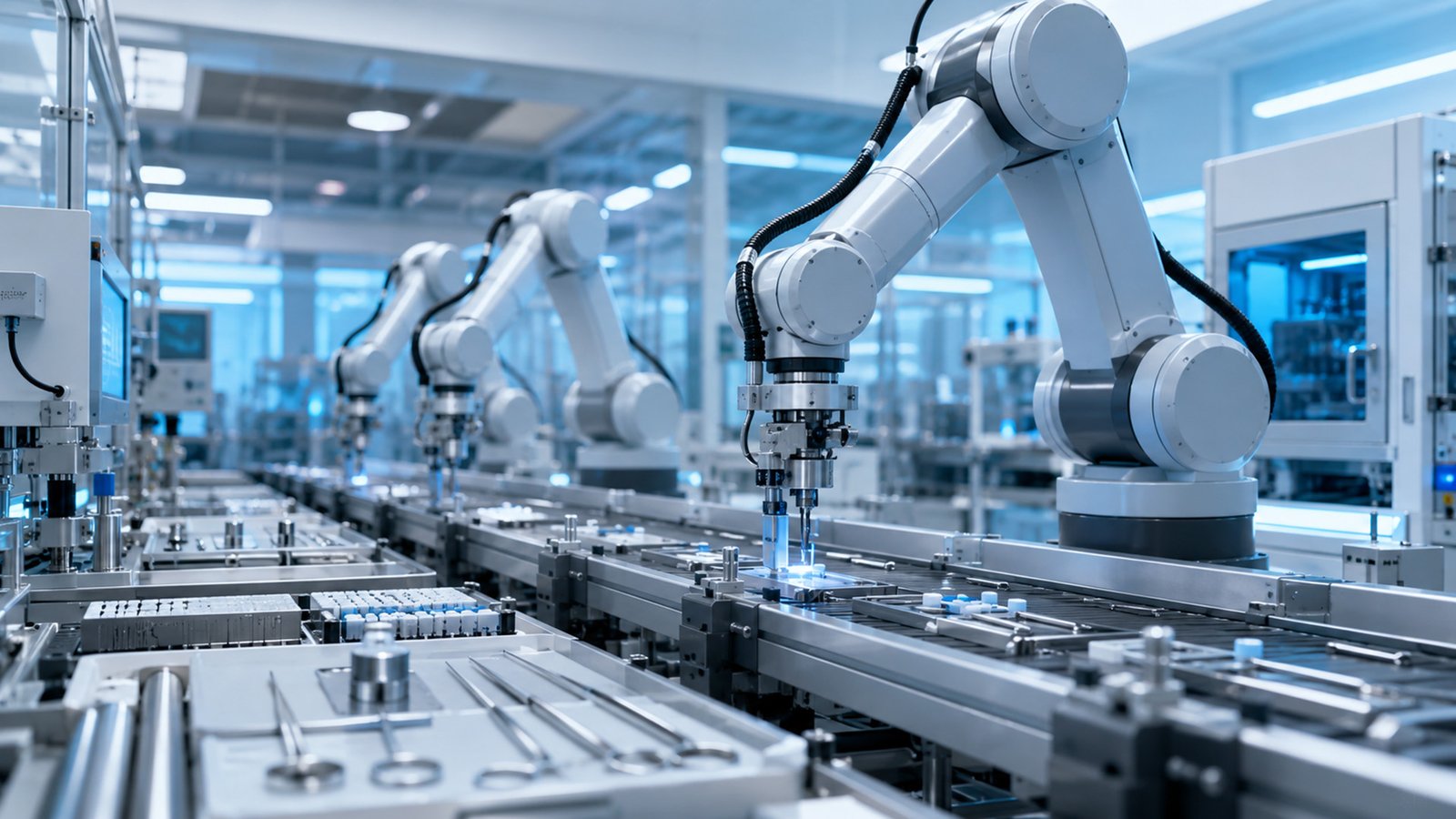
The production of medical devices is moving into a new age. Advanced healthcare systems demand medical devices and surgical instruments to be manufactured with increasing precision, consistency, and efficiency. As well as meeting increasingly stringent quality and regulatory standards. Meanwhile, hospitals, distributors, and healthcare procurement departments must have products that are consistent in their function, across all procedures and clinical settings.
Traditional manufacturing processes remain significant, especially in areas where traditional skills and knowledge are necessary. But if it’s done manually, it can be challenging to produce the same quality at large volumes. The demand is evolving with increased complexity, quality specifications,s and a need for faster production. Combined with variations in production, this is driving medical device manufacturers to adopt more automated and digitally controlled production systems.
Advanced technologies such as machine vision, machine control, digital monitoring, quality inspection, and robotics are integrated with the advanced machines. It use to enhance the manufacturing of medical products through automated manufacturing. Automation doesn’t eliminate the need for humans; it frees up time for skilled teams to concentrate on engineering, quality control, process optimisation, and other aspects that require expertise and judgment.
Modern healthcare organizations can’t afford this change to be limited to a factory floor. Improved manufacturing processes can help to achieve more consistent product quality, reliable supply, enhanced traceability, and increased confidence in procurement.
What Is Automated Manufacturing in Medical Device Production?
Automated manufacturing is the use of technology and controlled manufacturing systems to carry out manufacturing tasks with greater consistency and without relying on repetitive manual tasks. Automation applies to various phases in medical device manufacturing, ranging from material handling and component manufacturing through assembly, inspection, packaging, and production monitoring.
Automated systems can consist of computer numerical control equipment, robotic systems, machine vision, sensors, automated inspection technologies, and tools for digital production management, depending on the type of product being manufactured. These technologies can be used to assist manufacturers in managing critical factors and detecting potential deviations at an earlier point in the manufacturing process.
But despite all this automation, it does not necessarily mean that all aspects of the medical device production process need to be automated. There is still a great need for the human element, advanced testing, and finishing of medical and surgical goods. Ideal manufacturing environments are a blend of advanced technology and skilled personnel, ensuring a perfect balance of efficiency, accuracy, and quality control.
A manufacturer’s production process is an excellent way for hospitals and distributors to gauge their ability to supply them with consistent products in volume.
Why Medical Device Manufacturing Requires Exceptional Precision.
Precision is essential in the manufacturing of medical devices, as there are small variations that can impact the performance, usability, nd reliability of the product. Healthcare workers have to rely on medical products without fear of error when using them; they need to be made to a clear set of specifications. Products that are used in a hospital, such as surgical instruments, diagnostic equipment and other medically related items, have to be made to a precise set of specifications so that healthcare workers can use them without fear of error.
In a typical manufacturing setting, some repetitive manual work may cause batch-to-batch variations. This variability can be minimised by using automated equipment that can repeat controlled processes in accordance with set parameters.
This is especially useful when manufacturers have to make a large quantity of product with consistent specifications. Process control is high and repetitive tasks can be performed, for example, in cutting, shaping, assembly, measurement and inspection.
Consistency isn’t just a manufacturing advantage to healthcare organizations. It helps ensure that products delivered from various orders and production batches will be satisfactory.
Improving Product Consistency and Quality Control
One of the most crucial areas where automation can boost medical device production is in quality control. Routine quality checks are often based on manual sampling and manual visual inspection. While it’s important to have quality professionals on board, there are other layers of process monitoring available through automated inspection technologies.
During the production of the product, machine vision systems, sensors, and digital inspection equipment can be used for evaluation of specific product attributes. The aim of these systems can be to find out dimensional differences, assembly problems, surface defects, or other discrepancies from the requirements.
The big plus of this is that issues are picked up earlier. Manufacturers can detect a quality problem before the end of a large production run, rather than after, by keeping an eye on processes during the manufacturing process and taking corrective action sooner.
A high-quality system can include:
- Automated inspection and measurement technologies
- Established production parameters and process controls
- On-line tracking during key manufacturing steps.
- Recorded Quality Assurance Processes
- Final inspection by quality-trained professionals
The fusion of technology and human expertise results in a more holistic quality assurance strategy. Manufacturing controls can provide enhanced confidence in product consistency and supplier reliability, which is beneficial to hospitals and distributors.
Increasing Production Efficiency Without Sacrificing Quality
Medical device manufacturers often have to weigh two aspects: scaling up production and enforcing stringent quality standards. Healthcare demand can intensify the strain on manufacturers, especially during times of order surge by hospitals or distributors, or when they demand more orders or quicker replenishment.
Automation can increase production efficiency by decreasing repetitive manual work, optimizing work processes, and enabling some processes to be carried out in a more uniform and consistent fashion. By designing and managing production systems properly, manufacturers could be able to enhance productivity without deteriorating quality control measures.
Efficiency isn’t just about how fast things are done. Computerized systems can cut down on waste of unnecessary materials, pinpoint inefficiencies in the process, and boost resource utilization. Manufacturers can get a better understanding of where delays and inconsistencies are going wrong from digital production data.
An efficient manufacturing process for healthcare procurement teams can mean more reliable order fulfillment and better supply continuity. This is particularly vital where medical devices or surgical instruments are needed in more than one facility or healthcare market.
Supporting Scalability as Healthcare Demand Grows
The demand for health services is always changing. Demand for medical devices can be affected by factors such as population growth, increasing healthcare infrastructure, new clinical procedures, a nd shifts in market conditions.
It may be challenging for manufacturing companies that rely exclusively on labor-intensive production methods to scale up production rapidly without compromising product quality. In automated manufacturing, repeatable processes are standardized to create a more scalable production environment, and production capacity is improved.
Medical device distributors and healthcare companies with a presence in several markets are especially concerned with scalability. Such buyers are looking for suppliers who can handle fluctuating order quantities, while avoiding long lead times and quality control issues.
A scalable manufacturing system can aid in supporting:
- Larger production volumes
- Stable production schedule with reduced variation.Stable production schedule, less variation.
- Quick response to market demand changes.
- More uniformity among production runs
- Greater continuity of supply to healthcare customers
Scalability is a key factor to consider for procurement professionals, often as crucial as the present production capacity of a supplier.
Strengthening Traceability and Manufacturing Documentation
Traceability is a critical part of modern medical device manufacturing. Manufacturers require a clear production record, quality monitoring, materials,s and other information to aid quality management and regulatory needs.
Digital and automated manufacturing systems can increase data collection by documenting data at various points in the manufacturing process. This means that there is a more structured manufacturing history, and if there are issues identified, it becomes easier to investigate them.
Better traceability can aid in quality audits, process reviews, corrective actions, and product investigations. It also gives manufacturers valuable insights that can be used to find patterns and enhance future manufacturing.
Good documentation for healthcare buyers and distributors shows that a manufacturer has systems in place to ensure quality and accountability of its operations.
Supporting Regulatory Compliance and Quality Management
The medical device industry is a very regulated industry. Depending on the type of products manufactured and the markets in which they operate, manufacturers are subject to applicable quality management systems, technical requirements, and expectations of regulators.
Automation can help with compliance by providing more controlled and measurable manufacturing processes and making them repeatable. Digital records can also enhance documentation and help to ensure that defined procedures have been followed.
Automation does not ensure compliance, however! Manufacturers still need to have effective quality management systems, staff trained, documented procedures, validation (if applicable), and oversight.
Automated manufacturing is the key to helping support these systems. When used as part of a quality program, automation can lead to a more consistent process and insight into the production activities if implemented correctly.
Reducing the Risk of Human Error
While humans will always play a role in medical device making, repetitive manual work does present the possibility to screw up. If the processes involve the same action but are repeated, they can be affected by fatigue, inconsistent handling,g and differences in technique.
These risks can be mitigated by delegating repetitive and highly standardized tasks to controlled systems through automation. This enables the skilled workforce to specialize in areas where human judgment, technical knowledge, and problem-solving can be more useful.
For instance, trained personnel could monitor process performance, investigate process variations, and make quality decisions, whereas automated equipment may perform repetitive manufacturing or inspection processes.
This is not an elimination of people from manufacturing. On the contrary, it is a smarter application of human skills, backed by technologies that ensure repeatability of processes and control.
The Role of Robotics, Machine Vision, and Data in Modern Production
Medical device manufacturing is in the midst of a few technologies that are changing the future of the sector. Robotic technology can be used to aid repetitive assembly, material handling, and other well-controlled activities. Machine vision can be used to inspect product parameters at high speed, and sensors can be used to monitor production conditions and equipment performance.
Information is gaining significance in the same way. Information about the output, equipment performance, quality trends, and deviations in the process can be produced in modern production systems. This data can be used by manufacturers to identify inefficiencies and make informed decisions.
These technologies can be used over time for continuous improvement. Operational data is used to gain insight into the performance of processes and potential improvement areas, rather than waiting for problems to be identified post-production.
As manufacturers move towards a data-driven approach, medical device manufacturers are finding ways to become more responsive, transparent, and controlled in their manufacturing environments.
Common Challenges in Adopting Automated Manufacturing
Automation has numerous benefits, but it also presents some challenges that must be managed effectively. The production of medical devices may be very specialized, complex, and require high-quality standards. Not everything can be automated in production.
Common problems are:
- Requires large expenditures upfront for equipment and technology.
- Compliance with existing manufacturing systems
- Requirements and needs of employees in relation to technical skills.
- System reliability and equipment maintenance.
- The requirement for process validation and documentation.
- The risk of data leaks and security concerns.Data security and data management problems.
Thus, manufacturers have to make a strategic evaluation of their automation. It is not the objective to automate every process, but rather to seek an improvement in the quality, consistency, efficiency, and scalability that can be measured.
Automation can be a tool to meet manufacturing excellence, not just technology being used for the sake of using it.
Why Automated Manufacturing Matters to Hospitals and Medical Device Distributors
Hospitals and medical device distributors may not be directly involved in manufacturing activities, but manufacturing capabilities directly affect the outcome of the procurement process.
A supplier that has a controlled and scalable production process might be more equipped to ensure consistent quality production, to take larger orders, and adjust to demand fluctuations. Lessons learned from good production systems may also help to ensure more regular lead times and improved order fulfillment information.
Therefore, procurement teams should consider more than just the price of a medical device when assessing a medical device manufacturer. Key criteria are the manufacturer’s quality systems, production capacity, process controls, traceability, regulatory readiness, and the ability to meet long-term requirements.
These are significant points for distributors as supplier performance can have an impact on relationships with customer participants in the healthcare industry. Product delays or inconsistencies can be problematic in the distribution system.
Building a More Resilient Medical Device Supply Chain
Automated manufacturing also has a major contribution to make to the resilience of the supply chain. Reliable supply of medical products is essential for healthcare organizations, especially during times of surge demand or unforeseen events.
Efficient manufacturers with data-driven production systems might have better tools and resources to track production capacity, know where production might be limited,d and make adjustments to production planning. But with greater visibility into manufacturing operations, more informed decisions can be made, and quicker responses can be made to changing market conditions.
Even with automation, there are numerous risks in supply chains that can’t be eliminated. The availability of products may still be impacted by raw materials shortages, transportation issues, and world events. But for organizations with more robust manufacturing processes, they can create a more flexible operation and enable them to better respond to disruption.
As a healthcare procurement leader, you need to consider manufacturing resilience when choosing long-term suppliers more and more.
How AMG Medical Supports Quality and Reliability in Medical Device Production
At AMG Medical, we know that hospitals, distributors,s and health care providers don’t simply have products available and then sit back and wait. They have to have faith in the quality, consistency,y and reliability of the medical and surgical products they procure.
Our strategies are to ensure high-quality standards, ensure reliable production,n and foster long-term partnerships with healthcare stakeholders. AMG Medical takes advantage of its manufacturing capabilities, existing manufacturing techniques, and quality control systems in the industry to satisfy the evolving requirements of healthcare institutions and distributors throughout the world.
The best manufacturing partner for procurement teams should provide more than just a product catalogue. It needs to demonstrate a drive for quality, service responsiveness, a reliable supply, and a constant drive for improvement. These principles continue to be key for developing more robust and resilient healthcare supply chains.
The Future of Automated Medical Device Manufacturing
More automation, more digital technology,gy and more skilled human labor will be needed in the future production of medical devices. AI, predictive maintenance, advanced robotics, connected manufacturing systems, and ever-more sophisticated inspection technologies will continue to shape the manufacturing of medical products.
However, the best manufacturers won’t just take the technology for granted. They will apply automation to address practical manufacturing problems, enhance quality, better track product and process, and meet customer needs more effectively.
For the healthcare sector, which is in constant evolution, manufacturers who manage to link technological innovation with robust quality management will have greater possibilities to assist hospitals, distributors,s and healthcare professionals.
Conclusion
Automated manufacturing is increasingly vital for the modern production of medical devices, as it not only tackles some of the most important challenges in the medical device industry but also provides the necessary precision, quality control, reliability, consistency, and production capacity.
Automation can offer medical device manufacturers the chance to establish more controlled, scalable, and data-driven manufacturing environments. These enhancements can lead to increased confidence in hospitals and distributors, consistent product quality, and improved reliability in the supply chain.
The future is not just a matter of replacing human processes with machines in medical device manufacturing. It’s a matter of blending the high level of technology with the expertise of qualified personnel, quality systems, and ethical manufacturing practices, which result in a medical device that healthcare organizations can rely on.
With demand for safe, reliable, and high-quality medical products ongoing, automated manufacturing will play a critical role in helping to create a more efficient, resilient,t and future-proof medical device industry.
FAQS
What is automated manufacturing in medical device production?
Automated manufacturing incorporates technologies like robotics, computer-controlled machines, machine vision, and digital monitoring to enhance the consistency, efficiency, and quality assurance of manufacturing processes.
Why is automation important for medical device manufacturers?
By automating processes, manufacturers can help to minimize the variation in their products, increase production efficiency, enhance quality monitoring, and scale production without compromising their manufacturing processes.
How does automated manufacturing improve medical device quality?
The advantages of automated systems are to monitor production parameters and inspect defined product characteristics more consistently, thus enabling the manufacturer to recognize deviations earlier and have better process control.
Can automation help improve medical device supply chain reliability?
Yes. Production systems can be efficient and scalable, which will enable more predictable production capacity, better production planning, and a more predictable supply of medical products.
What should healthcare organizations consider when choosing a medical device manufacturer?
Product quality, manufacturing capabilities, quality management systems, regulatory compliance, traceability, delivery reliability, scalability, and long-term customer support are key areas that healthcare organizations need to consider.