

In modern healthcare, precision, durability, and consistency are essential to the performance of products used in surgical environments. Hospitals, ambulatory surgery centers, and healthcare distributors need dependable products that can support demanding clinical workflows while meeting strict quality expectations. AMG Medical partnered with a growing U.S. healthcare distributor to strengthen the quality of its product portfolio through advanced manufacturing, tighter process controls, and a standardized quality assurance framework.
The project focused on improving production consistency, reducing quality variation, and creating a more dependable sourcing model for facilities that rely on precision medical products.
Client Background
Northstar Surgical Partners is a U.S.-based healthcare distribution company serving ambulatory surgery centers, specialty hospitals, and private surgical practices across several states. The company sourced products from multiple surgical instrument manufacturers and surgical equipment manufacturers, but variations in finishing, durability, and production consistency created challenges for procurement teams and clinical users.
As demand increased, Northstar needed a more controlled manufacturing model capable of delivering consistent surgical instruments across growing order volumes. The leadership team also wanted stronger quality controls across its medical instrument portfolio while reducing the operational burden created by fragmented suppliers.
The Challenge: Inconsistent Quality and Supplier Complexity
The company was managing several surgical tools suppliers and surgical equipment suppliers to meet the needs of different departments and healthcare facilities. Because each supplier followed different production, inspection, and finishing practices, quality could vary from one shipment to another.
Procurement teams spent additional time reviewing specifications, inspecting samples, and resolving quality-related concerns. The company also needed dependable surgical medical supplies for recurring clinical demand, making consistency and reliability increasingly important to purchasing decisions.
The lack of standardized manufacturing controls created further concerns around durability, dimensional accuracy, finishing quality, and repeatability. To support long-term growth, the distributor needed a structured approach that connected manufacturing standards with measurable quality requirements.
Strategic Approach
Advanced Manufacturing & Precision Production
A manufacturing framework was introduced around precision machining, controlled finishing, standardized production procedures, and repeatable quality checks. The objective was to improve consistency across product categories while supporting increased production volumes.
Clear specifications were established for materials, dimensions, surface finishing, and functional performance. These controls created a more predictable production output and reduced variation between batches.
Supplier & Product Standardization
The sourcing model was redesigned around qualified production partners and documented quality requirements. Instead of relying on numerous surgical instrument manufacturers, the client adopted a more controlled supplier framework with clearly defined inspection criteria.
The same structured evaluation approach was applied when working with surgical equipment manufacturers, helping ensure consistent product specifications, documentation, and quality expectations across the broader portfolio.
Quality Assurance & Inspection
Quality checkpoints were incorporated throughout the production cycle, from raw-material verification to final inspection. Each batch was evaluated against established specifications before release, allowing potential deviations to be identified earlier.
This strengthened confidence in surgical tools suppliers by providing procurement teams with clearer visibility into quality performance. It also gave the organization a more consistent framework for evaluating surgical equipment suppliers and maintaining supplier accountability.
Implementation Process
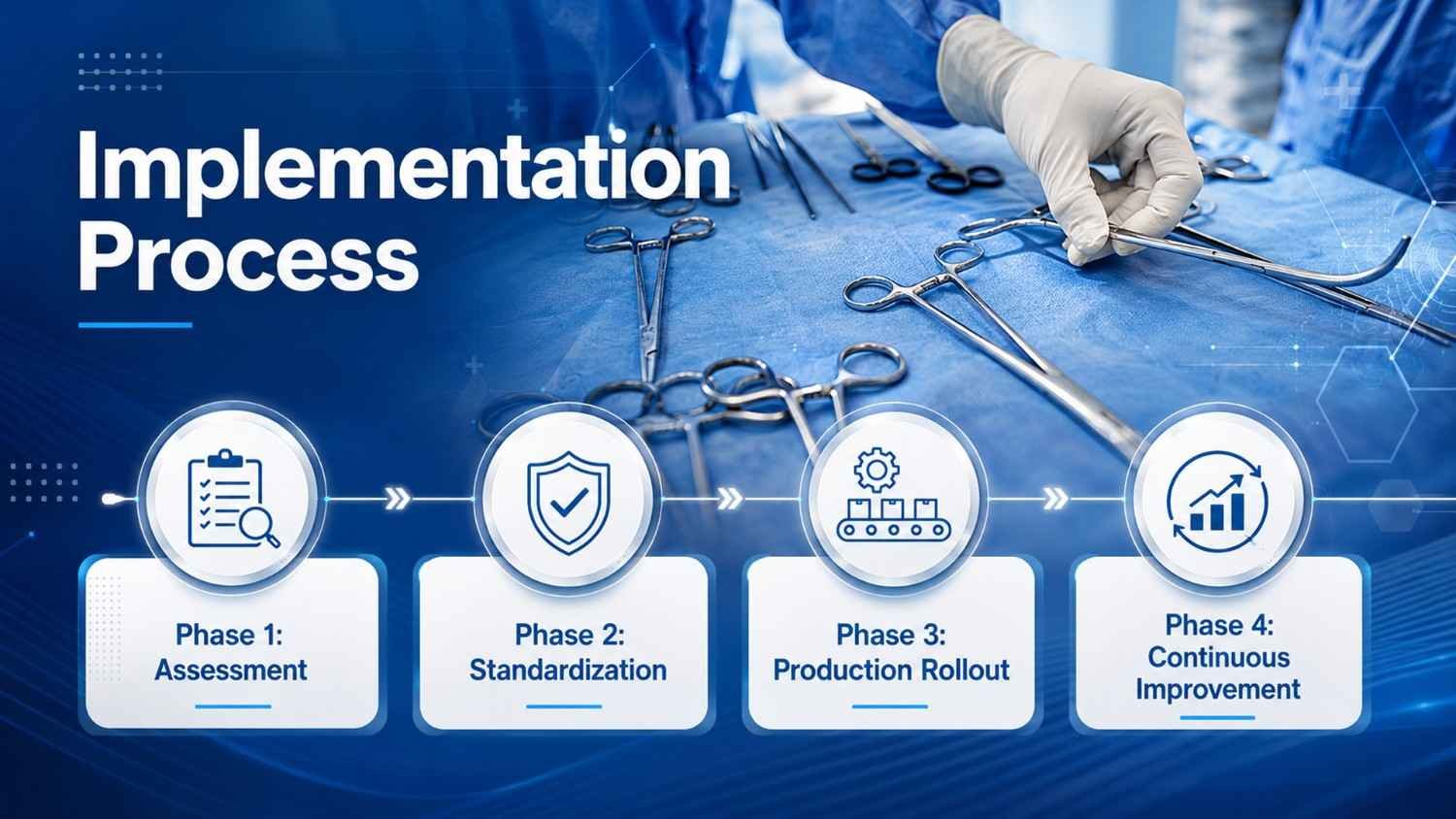
Phase 1: Manufacturing & Quality Assessment
The project began with a detailed review of product specifications, supplier performance, inspection procedures, and recurring quality issues. High-priority categories were identified for optimization, with particular attention to frequently ordered surgical instruments.
Phase 2: Process Standardization
Production specifications and inspection checkpoints were standardized to improve consistency. Material requirements, machining tolerances, finishing expectations, and packaging procedures were documented to create a repeatable manufacturing workflow.
Phase 3: Production Rollout
The optimized model was introduced across priority product categories. Manufacturing teams followed standardized procedures while procurement teams monitored quality performance across incoming surgical medical supplies.
Phase 4: Continuous Improvement
Quality data, inspection findings, and customer feedback were reviewed regularly. The information supported targeted process adjustments and helped maintain consistent performance as order volumes increased.
Results & Impact

The advanced manufacturing program improved product consistency, inspection performance, and procurement confidence across Northstar Surgical Partners’ portfolio. Standardized controls reduced quality variation and created a more predictable supply experience for healthcare customers.
The organization strengthened collaboration with qualified manufacturing partners and established clearer expectations for future supplier relationships. Improved supplier coordination also helped the procurement team evaluate vendors more efficiently and maintain stronger accountability across its network.
Overall, the project created a more reliable sourcing model, improved consistency across the instruments medical portfolio, and increased confidence in recurring orders.
Key Outcomes
- Improved manufacturing consistency across priority product categories
- More reliable inspection and quality-control processes
- Reduced variation between production batches
- Better procurement visibility and supplier accountability
- Improved confidence in product durability and performance
- More scalable production for growing U.S. healthcare demand
- Stronger quality foundations for long-term supplier partnerships
Conclusion
By combining advanced manufacturing, standardized specifications, and rigorous quality controls, the project helped Northstar Surgical Partners establish a stronger foundation for reliable medical product sourcing. The approach supported more consistent production, clearer supplier expectations, and greater procurement confidence.
The case demonstrates how a structured manufacturing strategy can help healthcare distributors improve product quality, strengthen supplier relationships, and support sustainable growth while meeting the performance expectations of modern clinical environments.